
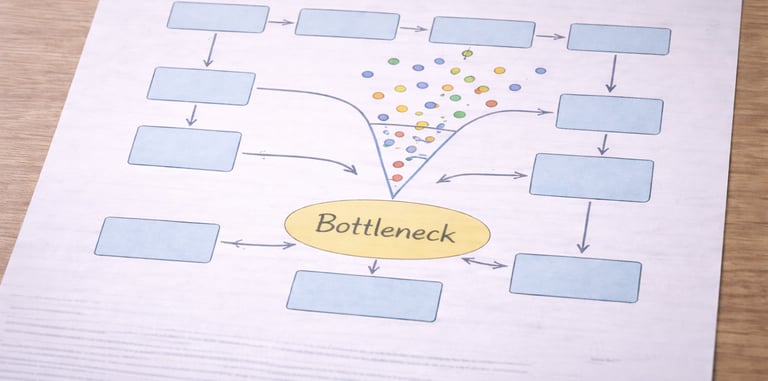
When work is already in motion but progress feels slow, adding new tools or automation won’t help. Bottlenecks form inside active workflows—at handoffs, wait states, and rework loops—where effort piles up and delivery stalls.
This complimentary self-diagnostic, valued at $49, helps you pinpoint where work is breaking down once it’s underway, so improvements remove friction instead of reinforcing it.
Workflow Bottleneck Self-Diagnostic
Find where work slows down before adding tools that amplify the problem
Why This Matters Before AI, Automation, or New Tools
AI and automation don't fix broken workflows. They execute whatever you give them, good or bad, faster and at scale.
If work is unclear, fragmented, or overloaded today, new tools often:
Automate steps that shouldn't exist
Reinforce existing delays, handoffs, and rework
Make problems harder to see once they're embedded in systems
Before you add complexity, you need a clear picture of how work actually flows today.
What a Workflow Bottleneck Really Is
A workflow bottleneck isn't just a slow step. It's any point where work consistently piles up, breaks down, or waits.
These issues often feel like execution problems, but they're structural.
Common bottlenecks include:
Decisions routed through the wrong people
Manual steps that no longer add value
Unclear ownership between teams or roles
Tools that don't match how work actually happens
Turn direction into results
Contact: hello@getemthere.com
Phone: (380) 268-1100
© Get'em There 2025. All rights reserved.
Questions?